
Understand the differences between SaaS, traditional BPO, and digital BPO—and why the agentic BPO hypothesis requires explicit boundaries, oversight, and operational accountability.
- SaaS provides access to software; as a rule, the customer remains responsible for operating the process.
- With BPO, the provider performs activities defined by scope and contract. In digital BPO, software and automation support that service.
- “Agentic BPO” is used here as a possible evolution—not as a regulatory category or a proven capability of any specific product.
- Automating steps does not eliminate the need to assign responsibility, handle exceptions, and oversee results.
For an SME, the question is not just which tool automates a task. It’s who performs the process, who handles whatever falls outside the norm, and who is accountable for the agreed work. This distinction separates software from services—and helps assess the idea of AI agent–enabled BPO rigorously.
Software and services are not the same engagement
Software as a service (SaaS) provides access to an application under its commercial terms. The customer company typically decides how to integrate it into its work, who operates the process, and how to handle errors and exceptions. The software provider is responsible for what is set out in the contract and offering, but that does not, by itself, mean it has taken on full execution of the company’s routine operations.
In a Business Process Outsourcing (BPO) service, the provider performs process activities according to an agreed scope and set of responsibilities. The practical difference is not just the technology used: it lies in the work undertaken, the service boundaries, quality criteria, and mechanisms for escalating issues.
That’s why buying a license and hiring an outsourced operation are different decisions. One can support the other, but they do not become equivalent just because both use automation.
Four models, four operational questions
| Model | What is being contracted | Responsibility to clarify |
|---|---|---|
| SaaS | Access to software and the services described in the offering | Who operates the process on the customer’s side, and who provides support for the application? |
| Traditional BPO | Performance of activities defined in the scope and contract | Which tasks, service levels, exceptions, and obligations belong to each party? |
| Digital BPO | Operational service supported by software and automation | How are technology and staff divided across execution, review, and escalation? |
| Agentic BPO hypothesis | Possible evolution in which AI agents perform steps or coordinate workflows within defined limits | Which actions are permitted, which require approval, and who is accountable for failures and exceptions? |
This comparison is conceptual. Actual contracts and offerings may vary; confirm scope, responsibilities, support, security, data, and acceptance criteria before signing. This article does not present “agentic BPO” as a universal definition or regulatory category.
A finance example—for illustration only
Consider an accounts payable routine. A tool may capture documents and organize information, if those features are available in the product you contract for. In an outsourced service, a team may perform steps defined in the contract. In a digital setup, software, automation, and professionals may share the workflow. In a scenario involving AI agents, some steps could be performed or coordinated automatically, but permissions, reviews, and exceptions would need to be specified.
This example does not describe a real implementation, claim that any product mentioned offers these features, or estimate savings, speed, or error reduction. It is a framework for asking questions before automating or outsourcing a process.

What may change—and what should not be left implicit
Automation can change who or what performs a step. It does not, on its own, define the authority to approve payments, correct data, interpret a discrepancy, or assume a contractual obligation. These decisions need to be documented between the customer and provider.
- Scope: Which inputs, tasks, and outputs are included?
- Exceptions: What happens when documents are missing, there is a discrepancy, or the system is not sufficiently confident?
- Control: Which actions require human approval, limits, or dual review?
- Responsibility: Who investigates, corrects, communicates, and records an error?
- Quality: Which indicators will be measured, how will they be defined, and by whom?
Human oversight does not have to mean manually reviewing every task. It means defining controls proportionate to the risk, monitoring results, and ensuring there is an escalation path for situations that should not be resolved automatically.
How to evaluate a proposal without confusing automation with a transfer of responsibility
Before comparing providers, describe your current process and its decision points. Then ask each provider to show what is software, what is operational work, and what remains the SME’s responsibility. A product demonstration, by itself, does not prove that the provider will take over the process or guarantee a business outcome.
- Map the steps, the data used, and recurring exceptions.
- Separate access to the tool from service execution.
- Review scope, obligations, support, security, privacy, and incident handling in the applicable documents.
- Define indicators and a baseline before claiming improvement.
- Test changes within a controlled scope, with clearly defined owners and stop criteria.
Where FinOps, Finance ERP, and FinAudit fit: OutSpace.team’s agentic BPO
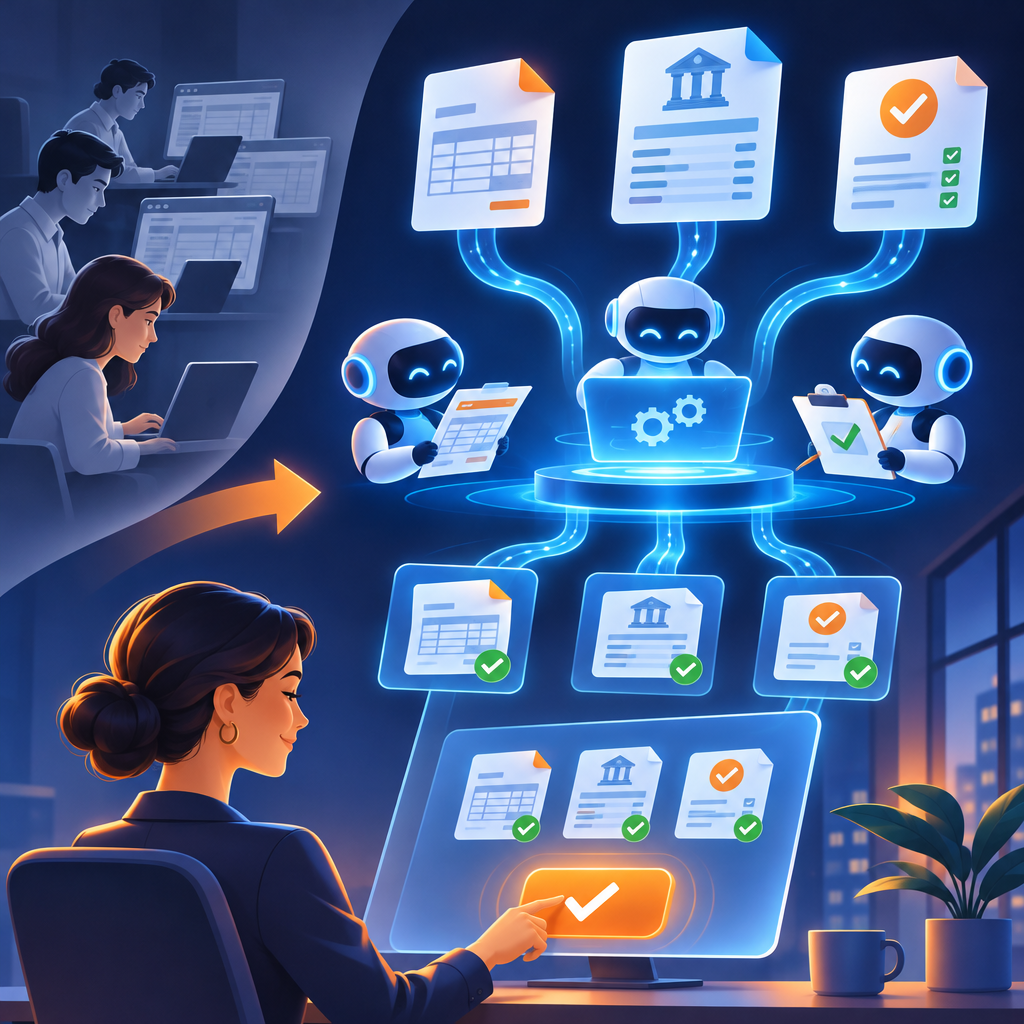
OutSpace.team brings financial BPO into the agentic model across three areas, which can be contracted together or separately. You don’t buy software just to keep entering data: you contract for the outcome, with a team of AI agents that does the work and only asks you to approve what matters.
- FinOps: financial operations carried out by agents. Five agents work in your Gmail, Calendar, and Drive: they read payment slips and invoices that arrive by email, schedule each due date, file the proof of payment in the right folder, reconcile each settlement against the statement, and manage cash. When something falls outside the norm, such as an amount 18% above average, the agent asks you to decide. You pay for each document resolved, not for the effort.
- Finance ERP: the ERP that posts, reconciles, and documents everything automatically. Every transaction becomes an immutable entry, with its supporting documentation alongside it. Balances, overdue payments, cash flow, and the income statement are ready every day, without spreadsheets, and you don’t have to replace your current ERP on day one.
- FinAudit: 100% transaction auditing. No sampling and no months of fieldwork: agents cross-check invoices, receipts, bank proofs, ERP entries, and accounting entries, and deliver each finding with the supporting evidence attached, in days. Ideal before an acquisition, investment, or closing the books.
That’s what sets agentic BPO apart from traditional BPO: 24-hour execution, audited and documented work, and governance with one-click human approval. The agents take on operational and repetitive tasks; your team focuses on decisions.
Join the waitlist for FinOps, Finance ERP, or FinAudit. Activation is rolling out in batches, and Orbit customers move to the front of the line.
An evolution that depends on explicit responsibilities
The discussion about agentic BPO is useful when it shifts the focus from “how many tasks AI can do” to “how the process is performed and governed.” Software, automation, professionals, and agents can all be part of an operation; the specific combination, however, depends on the product, contract, controls, and context of each company.
For an SME, the decision criteria remain practical: understand the scope, protect data, identify who handles exceptions, and measure what was agreed. Technology can support execution. Responsibility must remain clear.
Start with finance. Use the questions in this article to map your process and see how FinOps takes care of operations from end to end, with you approving only what matters.
Frequently asked questions
Is hiring SaaS the same as hiring a BPO?
Not necessarily. SaaS provides access to software; BPO involves performing activities within an agreed scope. The offering and contract determine the specific responsibilities.
What is digital BPO?
In this article, it is an operational service supported by software and automation, with the division of work and responsibility defined according to the contracted scope.
Is agentic BPO already a formal category?
This article uses the term as a possible evolution of operations that may involve AI agents. It does not present it as a regulatory category or universal definition.
Do AI agents eliminate the need for human oversight?
You should not assume that. Permissions, reviews, exceptions, escalation, and owners need to be defined according to the risk and the process.
Do FinOps, Finance ERP, and FinAudit provide BPO?
Yes. They are OutSpace.team’s agentic financial BPO: FinOps handles operations (invoices, payment slips, payments, and reconciliation), Finance ERP maintains documented entries along with cash flow and the income statement, and FinAudit audits 100% of transactions. You approve what matters; the agents handle the rest.