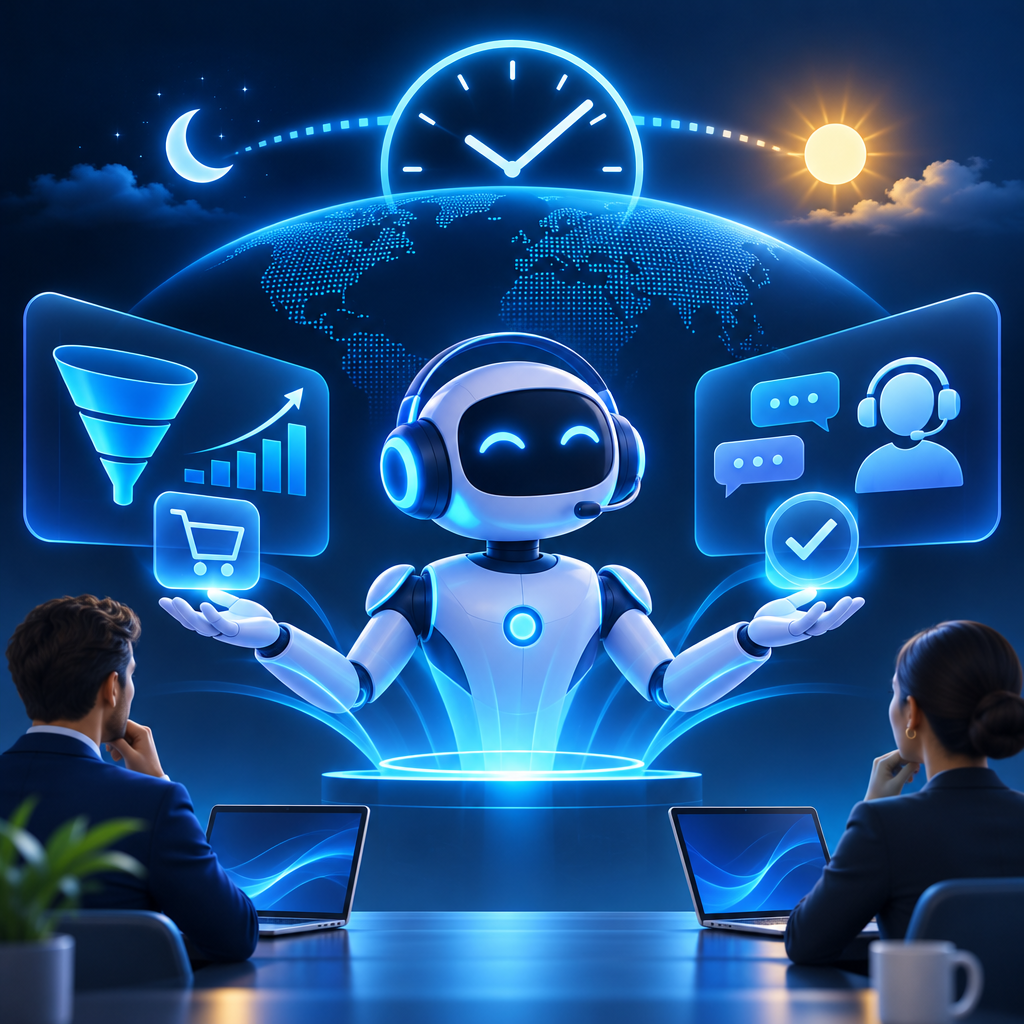
How AI agents can respond, qualify leads, follow up, and support customers around the clock across WhatsApp and CRM—helping businesses reduce missed opportunities without scaling headcount at the same pace.
- AI agents can respond to leads and customers beyond business hours.
- They can help qualify inquiries, maintain follow-up, and provide continuous support across channels such as WhatsApp and CRM.
- The business outcome is more consistent engagement and fewer opportunities left waiting, without scaling headcount at the same pace.
A prospect can message your business after the workday ends. If nobody responds until morning, interest may fade before the conversation begins. AI agents can help teams respond, qualify, and follow up across channels such as WhatsApp and CRM—so every interaction has a clearer path forward.
The after-hours gap is a sales and service problem
Customers do not always reach out during office hours. A delayed response can leave a potential buyer waiting, while a support request stays unresolved. As inquiry volume grows, asking people to monitor every channel around the clock is difficult to sustain.
This creates an operational gap: the business may be available in theory, but the next step depends on someone noticing the message, understanding it, and responding promptly. AI agents can help cover repeatable interactions when the team is busy or offline.
AI agents can move a lead from inquiry to next step
A useful agent does more than send an instant acknowledgment. It can engage with an inquiry, ask relevant questions, capture context, and help identify whether the prospect is ready for a sales conversation. That makes the interaction more actionable for both the prospect and the team.
Qualification should be grounded in the business’s actual criteria. The agent can collect information and route the conversation, while people retain responsibility for nuanced decisions, exceptions, and commitments that require human judgment.

Follow-up becomes a workflow, not a memory test
Many opportunities stall because the next follow-up is delayed or forgotten. AI agents can support proactive outreach by keeping track of the conversation and prompting or carrying out an appropriate next step, according to the workflow and permissions configured by the business.
The objective is continuity, not more messages for their own sake. A follow-up should reflect the prospect’s context, respect their preferences, and make it easy for a human teammate to take over when the conversation needs expertise or approval.
Customer support can stay responsive across channels
Customers want useful answers without having to wait for the next office day. AI agents can provide continuous, personalized support across channels such as WhatsApp and CRM, handling routine questions and preserving context so that interactions are easier to continue.
Well-designed support also defines what the agent should not do. When a request is unclear, sensitive, or outside its scope, the interaction should be directed to a person rather than answered with unsupported certainty.
Scale engagement without scaling headcount at the same pace
AI agents can expand a team’s capacity to engage with leads and support customers by taking on repeatable interactions. This can help businesses maintain more consistent coverage without adding people in direct proportion to every increase in inbound volume.
That does not mean removing human oversight. Teams still define the rules, review performance, handle exceptions, and improve the workflows. The strongest operating model combines automated execution for routine steps with clear human ownership for decisions and escalations.

Measure outcomes, not just agent activity
Counting conversations or agent runs alone does not show whether automation is helping the business. Evaluate whether inquiries receive timely responses, whether qualified leads reach the right sales step, whether follow-ups happen as intended, and whether support requests are resolved satisfactorily.
Also review handoffs, unanswered questions, customer feedback, and cases where the agent acted outside the intended workflow. These signals help teams refine the experience and identify where a human should enter sooner.
Build a reliable AI-agent workflow
- Choose a focused use case. Start with a repeatable sales or support interaction where a faster response has a clear operational benefit.
- Define the boundaries. Specify what the agent may answer, what information it can collect, and when it must escalate.
- Connect the interaction to the workflow. Make sure the conversation’s context and next step are available in the team’s sales or support process.
- Keep people accountable. Assign owners for exceptions, approvals, and ongoing review.
- Track business results. Compare response timeliness, qualification progression, follow-up completion, resolution quality, and handoff rates.
AI agents become a practical sales and support engine when every interaction has a defined purpose, a safe path forward, and a measurable outcome. They can help businesses respond beyond office hours, qualify and follow up more consistently, and provide continuous customer support—while people stay responsible for judgment and the experience the business promises.
Frequently asked questions
What can AI agents do for sales and support?
They can engage with inquiries, ask relevant qualification questions, support follow-up, and answer routine customer questions across channels such as WhatsApp and CRM.
Do AI agents replace sales or support teams?
No. They can handle repeatable interactions and help maintain coverage, while people remain responsible for decisions, exceptions, escalations, and human relationships.
How should a business measure AI-agent performance?
Measure operational and customer outcomes such as response timeliness, qualification progression, follow-up completion, resolution quality, and handoff rates—not only the number of agent interactions.
Where should a business start with AI agents?
Start with one repeatable sales or support use case, define the agent’s permissions and escalation rules, connect it to the existing workflow, and review measurable results.